

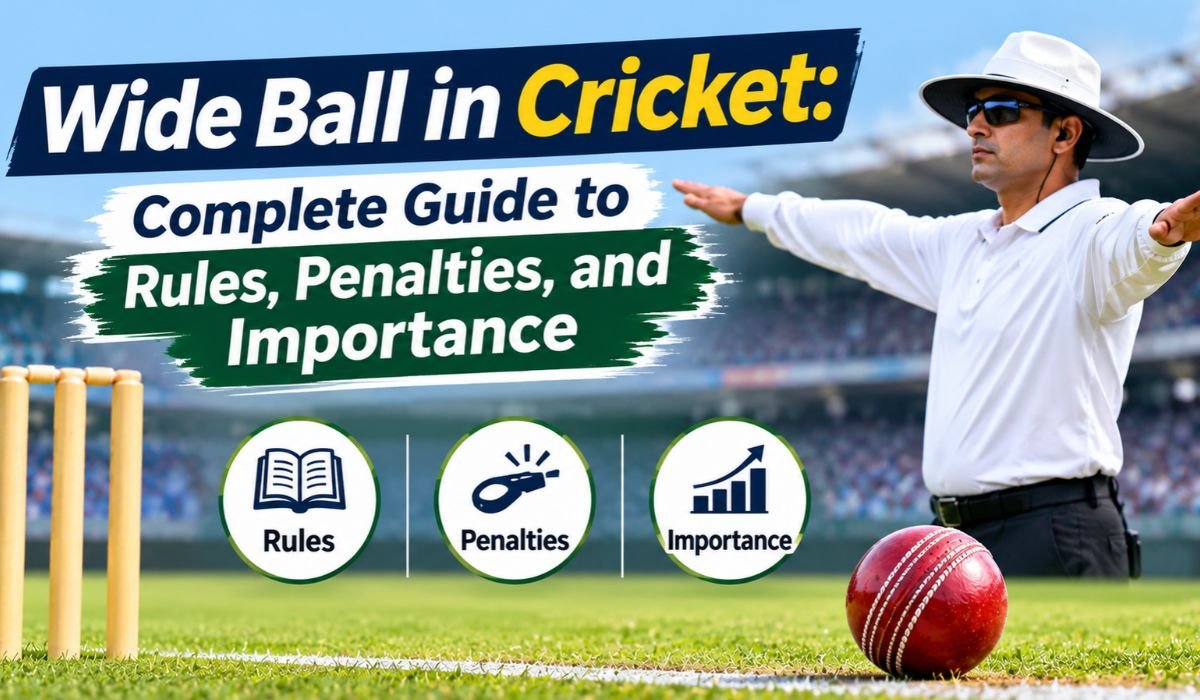
Cricket is a sport that operates under an extensive collection of rules; however, there are many rules that have generated both discussion and confusion among spectators (whether casual or devoted). One such rule is the “wide” in cricket. To truly comprehend the technical and strategic elements of the game, it is necessary to understand what constitutes a wide ball in cricket. The purpose of this article is to provide you with all of the information required to understand the wide ball in cricket, including its definition, rules, penalties, history and how it affects current-day matches.
What is a Wide Ball in Cricket ?
A wide ball in cricket is defined as a ball delivered by a bowler which is so far away from the batsman that it would be extremely difficult for him to make a regular cricketing stroke. The umpire at the bowler’s end is responsible for determining whether a wide ball has occurred, and he signals this decision with horizontal arm movements. This rule is designed to provide equal opportunities for all players, preventing bowlers from intentionally delivering balls outside the range of the batsman in order to minimize their chances of conceding runs or wickets.
A wide ball in cricket is used to create a balance between the bowler and batsman, giving both parties an equal opportunity to compete on even ground. If there were no wide ball rule, then the bowler could simply throw the ball so far away from the batsman (or over his head) that he cannot hit it, therefore restricting scoring and creating an unfair advantage for the bowler.
Official Definition According to the Laws of Cricket
A “wide ball” in cricket is defined by Law 22 of the MCC (Marylebone Cricket Club) Laws of Cricket, and is determined by where the ball travels in relation to the batsman’s guard position and the width of the pitch. A ball will be called a “wide ball” if it goes past the imaginary return crease lines that are extended, or if it travels above the batsman’s head while he stands upright at the crease.
The specific requirements for when a wide is called may vary slightly based upon what type of match is being played (Test cricket, One Day Internationals, or T20 cricket), which is described in greater detail throughout the remainder of this piece.
Why is the Wide Ball Rule Important?
The wide ball in cricket rule serves several crucial purposes:
- Fairly Against the Batsman – This prevents a bowler from delivering a ball that a batsman would not be able to fairly attempt to hit.
- Maintaining Game Balance – In cricket, a “wide” ball will punish overly defensive and cautious bowling strategies.
- The use of encouraging attacking cricket means that as a result of the bowlers being forced to bowl into an area of the pitch in which the batsman can reasonably expect to make contact with the ball, the contest between the batsman (with his bat) and the bowler (with the ball) becomes much more interesting.
- Every wide ball in cricket will result in one extra run for the batting side and a re-bowling of the delivery.
Runs and Penalty for a Wide Ball
The umpire will signal a “wide” ball whenever it crosses outside of the line of flight for a batsman to hit. When a wide ball is called, the batting team receives one run, which is listed as an “extra” on the scorecard and doesn’t affect a batsman’s individual score. Also, the ball has to be re-bowled so that there are six legitimate deliveries before the over can be completed.
In some cases, if the ball is hit past the boundary after it has been declared “wide,” the batting team will receive five runs as opposed to just one run. The five runs are made up of four runs for the boundary hit and one run for the “wide” ball. It is common for this type of situation to occur when a “wide” ball passes the wicketkeeper without touching him and then rolls all the way to the boundary rope.
Different Formats and Wide Ball Rules
The way a wide ball is interpreted in the various forms of the game of cricket differs slightly from format to format. To see how these differences apply, please refer to the following comparison table.
| Format | Wide Ball Margin (Off Side) | Wide Ball Margin (Leg Side) | Extra Runs Awarded | Stricter Rules? |
| Test Cricket | Standard width outside off stump | Standard width outside leg stump | 1 run | Less strict |
| One Day International (ODI) | Narrower margin than Tests | Narrower margin, especially for leg-side deliveries | 1 run | Moderately strict |
| T20 Cricket | Narrowest margin among all formats | Very narrow margin on leg side | 1 run | Most strict |
| T10 Cricket | Extremely narrow margin | Extremely narrow margin | 1 run | Strictest |
As shown by the data in the table above, the rules for calling a wide ball in cricket are increasingly restrictive as the length of the match decreases. The reason for this is that shorter formats of cricket (such as T20 and T10) emphasize high-scoring games played at a rapid pace. Therefore, umpires will call a wide ball in cricket much sooner than they would in a longer format to help eliminate negative bowling tactics.
Common Scenarios Leading to a Wide Ball
There are a number of common scenarios that result in a wide ball being signaled by the umpire during a cricket game:
- The Bowler Delivers Too Far Down the Leg Side: A delivery that is bowled so far down the leg side (away from the batsman) that he/she cannot possibly hit it is called a “Wide Ball.”
- The ball was thrown too wide outside of the off-stump. This means that the ball is either thrown too far outside of the off-stump or passes through an area that is outside of the batsman’s normal hitting area. This is called a “wide” in the game of cricket.
- The bouncer above the head is a short pitched delivery that travels higher than the batsman’s head when he stands at his normal height. This type of delivery will result in being called a wide ball in cricket.
- In some cricket leagues, if a player throws a ball that goes above the height of their shoulder, they will be given a “wide” in terms of how many runs are scored off that delivery.
Table: Wide Ball Signal and Umpire Communication
| Action | Description |
| Signal Gesture | Umpire extends both arms horizontally, parallel to the ground |
| Communication to Scorer | Umpire verbally confirms “wide ball” to the scorers |
| Re-bowling Requirement | The delivery must be bowled again as it doesn’t count in the over |
| Run Addition | One run instantly added to the team’s total as an extra |
| Boundary Wide | If ball reaches boundary, 5 runs awarded (4 + 1 for the wide) |
This table clearly demonstrates how a “wide” in cricket is signaled by an umpire, recorded on the scorebook by a scorer, and punished with a penalty run for the batting side during the course of a match.
Historical Background of the Wide Ball Rule
The wide-ball regulation in cricket has been modified substantially over the course of time since cricket’s inception. There was nothing formal about wide balls during the nineteenth century, so bowlers were given the opportunity to deliver the ball to whatever part of the pitch they wanted. However, when cricket became a more organized and equitable game, the wide-ball regulation was implemented to reduce the advantages that some bowlers could gain from delivering wide balls and also to protect the rights of both the batsman and the spectator.
Over a period of time (particularly after the advent of limited-overs cricket in the 1970s), there has been an increased refinement and strictness of the rules regarding a “wide” in cricket. Additionally, the development of T20 cricket in the early 2000s has resulted in an additional tightening of the regulations concerning “wides,” as administrators sought to provide fans with more exciting and high scoring games.
Role of Umpires in Calling a Wide Ball
A wide ball can only be called by the on-field umpire who stands at the bowler’s end. Calling a wide requires great judgment, focus, and knowledge of what constitutes an acceptable wide in each type of game. Although technology such as the Decision Review System (DRS) has introduced a potential way to help umpires make decisions regarding wide balls, the vast majority of wide ball decisions are still made based upon the on-field umpire’s judgment.
An umpire must take into account how far forward an individual batsman is standing, how much he moves prior to the delivery being bowled, and the angle of flight of the ball when deciding if a wide ball in cricket will be indicated. As such, this decision is one of the more open to interpretation, however, it remains one of the most significant made throughout a cricket match.
Impact of Wide Balls on Match Outcomes
A high frequency of wide balls may significantly impact the outcome of a cricket match. Especially when there is a close game with little margin for error, particularly in limited overs cricket, every run is crucial. A series of wide ball deliveries will likely:
- Increase the overall run total of the batting team significantly.
- Disrupt the bowling team’s rhythm and strategy.
- A cause of greater stress for the bowler, particularly during critical game periods such as the last few overs.
- To potentially change the tide of a close game in favor of the team that is batting when they are chasing a target.
As such, the emphasis that teams and bowlers place upon their ability to maintain both accurate and disciplined bowling is primarily focused on reducing the occurrence of wide balls within cricket matches, particularly those with high pressure such as the T20 World Cup or IPL finals.
Strategies to Avoid Bowling Wide Balls
Bowlers and coaches spend many hours working on accuracy and controlling the line they bowl, to reduce how often they bowl wide balls in cricket. There are several ways that bowlers and coaches can do this, including:
- The bowlers should consistently work on their line and length. They can do this by having regular practice sessions to focus on bowling within the correct margin.
- Focus On Mental Clarity During Pressure Moments – Keep your cool during pressure-filled overs so that you don’t make hurried, inaccurate deliveries.
- Umpire Bias – Experienced bowlers will frequently make minor adjustments to their delivery style depending upon whether the umpire for the match is calling wide-balls as such.
Many franchises are using technology during training to provide bowlers with a more accurate understanding of where they should be delivering the ball and at what length. This provides bowlers with a better opportunity to reduce the number of wide balls bowled in actual matches.
Conclusion
The concept of the “wide ball” in cricket is a core principle designed to ensure equity, maintain a reasonable level of competition between batsmanship and bowling, and provide an interesting and competitive experience for fans globally. Through its long history and various interpretations based upon form (i.e. Test, One Day International (ODI), Twenty20 (T20), and Ten10 (T10)), the intricacies of the “wide ball” will allow one to appreciate the game of cricket even further. Players, coaches, umpires and avid fans must understand the regulations regarding the “wide ball” in order to properly comprehend the complex yet simple aspects of this international sport.
Frequently Asked Questions
1. What is a wide ball in cricket?
A “wide” in cricket occurs when a bowler delivers a ball that is either too far away from the batsman (outside of the off-stump area), too far down the leg-side area, or too high over the batsman’s head. When this happens, the batsman cannot play the ball with a regular cricket stroke.
2. How many runs are awarded for a wide ball?
Normally, one run is given when a wide ball occurs. However, if the wide ball hits the boundary before it can be hit, then a total of five runs will be awarded (four for hitting the boundary, and one for the wide).
3. Does a wide ball count as a legal delivery in the over?
No, a wide ball is not a valid delivery. Therefore, the bowler will have to bowl the ball again, and the over will not be complete until the bowler bowls six valid deliveries.
4. Are wide ball rules the same in Test cricket and T20 cricket?
No, the rules governing what constitutes a wide ball in a T20 match are typically more restrictive than those used in a Test match, since the faster-paced nature of the shorter format emphasizes action-packed and entertaining games.
5. Can a batsman be dismissed off a wide ball?
Yes, a batsman can be out off a wide delivery in some circumstances (e.g., stumped or run-out), although the delivery itself was a wide.
6. Who decides whether a ball is a wide ball in cricket?
The on-field umpire who stands at the bowler’s end will judge and signal a wide ball depending on where the batsman is and what path the delivery takes.