

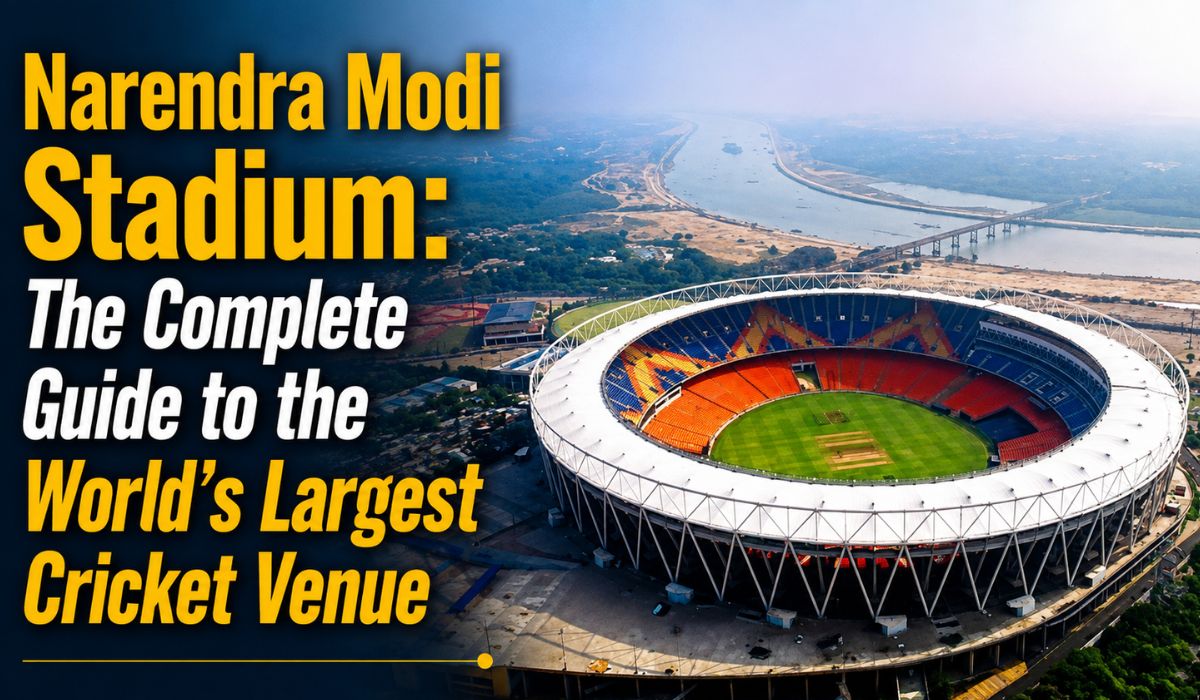
The Narendra Modi Stadium is not the only temple of cricket in India, but it is the biggest, the most stately and highest on everyone&039;s current talking points list. Not just a cricket ground located in the Motera locality of Ahmedabad, Gujarat the structure is an engineering marvel and a monument to Indian sporting ambition, right now it is also a big middle fingered joke given that it measures scale vs 3rd largest today: Size. It seats more than 1,32,000 spectators and has transformed the face of a sporting arena in the 21st century.
This article takes a look at the full history, architecture, capacity, facilities, career records and importance of the Narendra Modi Stadium as well as tables summarizing key facts and FAQs about this iconic venue.
Introduction to Narendra Modi Stadium
The Narendra Modi Stadium is located on the banks of Sabarmati River, a huge piece of land that was initially allocated for cricket as far back as the early 1980s. It started small a 49,000-capacity ground and, four decades on, has grown to almost outgleam any stadium in the world of sport, cricket or otherwise. Today, it is one to the finest cricketing venues in the world and still owned and operated by Gujarat Cricket Association(GC).
The stadium is the current home ground of the Gujarat Titans franchise in IPL and it regularly organises international fixtures in all formats Test, ODI & T20I. Its sheer size means that it can contain record-breaking crowds and transform every match into a carnival of cricket.
History and Evolution of the Narendra Modi Stadium
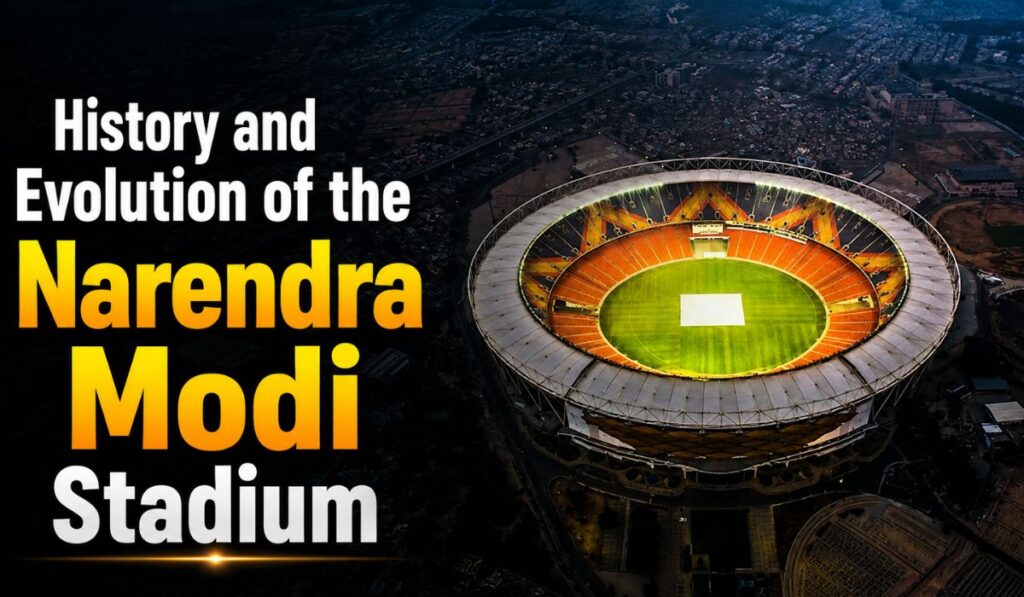
This iconic ground that you follow the story of long before it carried this name. The Sardar Patel Stadium came up in 1982 on land given for free by the Gujarat government. Oh, and the whole structure was built in a matter of nine months, before hosting its first Test between India and West Indies back on November 1983.
The Sardar Patel Stadium would go on to become a cherished ground over the next few decades hosting three different editions of the Cricket World Cup: in 1987, 1996, and 2011 as well as a plethora of unforgettable Test and ODI matches. This is where Sunil Gavaskar scored 10,000 Test runs, and this is also where Kapil Dev first became the highest wicket-taker in Test cricket history.
But by 2015 the old building had become very old, GCA thought it was time for a total makeover. Out with the old, in with the shiny: The stadium that once stood was torn down and completely replaced by a new hosting pretty when many facilities are near ultra-modern. It led to the redevelopment over a period of around five years to what is currently being called the Narendra Modi Stadium.
Ground Historical Milestones of the data – Table As displayed in table below.
| Year | Milestone |
| 1982 | Original Sardar Patel Stadium constructed on land donated by the Gujarat government |
| 1983 | First Test match hosted (India vs West Indies) |
| 1987, 1996, 2011 | Hosted matches during three separate ICC Cricket World Cups |
| 2006 | Renovated ahead of the Champions Trophy with new pitches and floodlights |
| 2015 | Old stadium demolished to begin large-scale reconstruction |
| 2020 | Reconstruction completed; new stadium inaugurated |
| 2021 | Renamed the Narendra Modi Stadium in a formal ceremony |
| 2022 & 2023 | Hosted back-to-back IPL Finals |
| 2023 | Hosted the ICC Cricket World Cup Final |
Read Also:- Most Wickets in IPL 2026 | India National Cricket Team vs Australian Men’s Cricket Team Match Scorecard
Why Was It Renamed Narendra Modi Stadium?
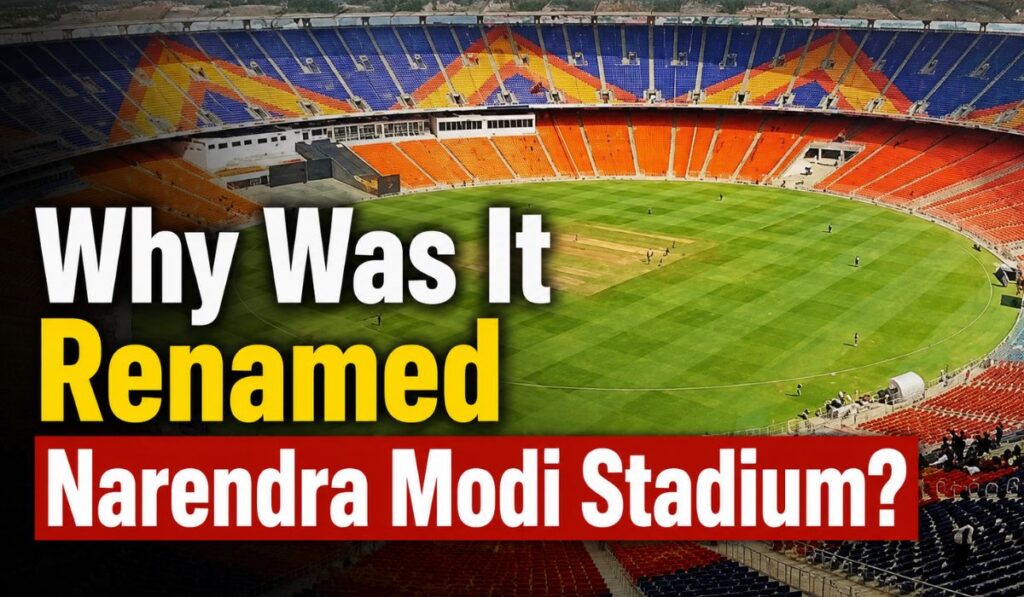
On 24 February 2021, this stadium was formally renamed after Prime Minister Narendra Modi who had been the president of the Gujarat Cricket Association from 2009 to 2014 and then Chief Minister of Gujarat at a time when this redevelopment project was conceptualised. That verdict to rename the ground acknowledged his status as the catalyst behind taking a small local used venue and developing it into what is now the biggest cricket stadium in the world. In fact it is considered one of the first and largest such public sports infrastructures in India to be named after a sitting Prime Minister which makes it both pride and contentious publicly.
It hosted its historic first pink-ball Day-Night Test match on the same day where dignitaries attended the renaming ceremony as well as that between India and England.
Capacity and Architecture of Narendra Modi Stadium
The Narendra Modi Stadium has one most salient characteristic: its size. At over 1,32,000 spectators you will safely keep almost double the MCGs capacity of 100,000 people making this not only the worlds largest cricket ground but also the world largest stadium for any sport anywhere on planet Earth.
The stadium was built by one of India’s largest engineering and construction companies Larsen & Toubro (L&T) and the design was made by Populous, an event architecture firm globally. According to the developer, the stadium complex spans an area on par with roughly 32 Olympic football fields about how big this venue really is.
The seating at this ground (like that of several others) is arranged in two levels lower bowl, upper bowl creating the effect that smaller matches should seem full and lively by commencing with the filling of the lower tier. The stadium consists of eleven stands: the President’s Gallery, Adani Lower and Upper Pavilions; Club Pavilion; West Pavilion; GMDC Lower and Upper Pavilions and North & East Stands.
Below is a summary of the stadium key specifications:
| Feature | Details |
| Location | Motera, Ahmedabad, Gujarat, India |
| Total Capacity | Approximately 1,32,000 spectators |
| Owner | Gujarat Cricket Association (GCA) |
| Architect | Populous |
| Construction Company | Larsen & Toubro (L&T) |
| Reconstruction Cost | Approximately ₹800 crore |
| Reconstruction Period | 2015 to 2020 |
| Renamed | 24 February 2021 |
| Number of Stands | 11 major stands |
| Practice Pitches | 6 indoor and 3 outdoor practice areas |
| Corporate Boxes | 76 boxes with seating for 25 people each |
| Car Parking | Around 3,000 cars |
| Two-Wheeler Parking | Around 10,000 vehicles |
| Home Team (IPL) | Gujarat Titans |
Read Also:- Ranji Trophy 2026 Winner | Pakistan National Cricket Team vs India National Cricket Team Timeline
Facilities Available at Narendra Modi Stadium
The stadium is a self-contained sporting complex beyond the playing area. One of the most high-tech venues in world cricket, it boasts a plethora of facilities for both spectators and athletes. The facilities consist of an indoor cricket academy which accommodates about 40 athletes overnight, along with four team dressing rooms, a clubhouse with three practice grounds, swimming pool, badminton and tennis courts, squash facility as well as a table-tennis area and even a 3D projection theatre.
There is a massive ramp system into and out of the venue, which can accommodate upward of 60,000 people on match day without excessive congestion. It is also directly connected to the nearby metro station via a skywalk, which further helps ease the congestion for the tens of thousands of fans who throng there during marquee matches.
Floodlights, modern drainage systems and excellent broadcasting facilities complete the development that satisfies all requirements necessary to host the biggest occasions in world cricket at a stadium level.
Major Events Hosted at Narendra Modi Stadium
The venue has now become one of the most important highly-established cricketing venues since reopening. In February 2020, it was the venue of the iconic “Namaste Trump” event with then-US President Donald Trump addressing a huge gathering here. It also hosted the first of its kind Test between India and England, followed soon after by the IPL bio-bubble tournament in those pandemic years.
One of the biggest highlights in the more recent timeline for the Narendra Modi Stadium was in November 2023, when it hosted India and Australia in the final of the ICC Cricket World Cup. Despite the home sides disappointment, it established the venue as a world-class venue capable of facilitating cricket’s biggest stage when full.
The stadium has hosted over 100 T20 matches, including multiple IPL finals, in 2022 and 2023 as well as being the home ground of franchise Gujarat Titans. The ICC has also used it as part of the rotation for its big tournaments, which only serves to further establish the venue on a global scale.
| Notable Event | Year |
| Namaste Trump event | 2020 |
| First Day-Night Test (India vs England) | 2021 |
| IPL Final | 2022 |
| IPL Final | 2023 |
| ICC Cricket World Cup Final (India vs Australia) | 2023 |
| ICC Men’s T20 World Cup fixtures | 2026 |
Records at Narendra Modi Stadium
The venue has been privy to several cricketing milestones, with that history going back decades under both its previous name and the newer one. Sunil Gavaskar scored the 10,000th run at this very venue in 1986-87 and Kapil Dev also took his 432nd Test wicket here in 1994 which made him the highest wicket-taker in Tests (albeit for a short period of time). This ground has a legacy in itself being the venue where Sachin Tendulkar became the first batsman to score 30000 International runs in 2013.
Now, the newly-constructed stadium has given us its own set of records. The highest successful run-chase in an ODI at the venue is 325 runs while teams have successfully chased totals of up to 166 in T20 cricket. It has also registered the least total in each format and highlighted how unforgiving can be the surface at Narendra Modi Stadium as it is flattering for batsmen on the best days.
| Record Category | Detail |
| Highest ODI Total Chased | 325/5 (IND vs WI, 2002) |
| Highest T20I Total Chased | 166/3 (IND vs ENG, 2021) |
| Lowest Test Total | 76/10 (IND vs RSA, 2008) |
| Lowest ODI Total | 85/10 (ZIM vs WI, 2006) |
| Lowest T20I Total | 66/10 (NZ vs IND, 2023) |
| Most Test Runs at Venue | Rahul Dravid – 771 runs |
Read Also:- India National Cricket Team vs Afghanistan National Cricket Team Match Scorecard
Pitch Behavior and Playing Conditions
An interesting aspect to players, commentators and analysts alike is the behaviour of the turf over different formats & seasons. When it was the Sardar Patel Stadium though, the pitch tended to benefit bowlers quite a bit with many of the early Test matches ending outright in just a couple of days. Since the redevelopment though, the surface has matured into an altogether more even deck which plays to well-balanced batting line-ups, particularly in white-ball cricket, but particularly offers up something for spinners as a match wears on.
Generally, the pitch is true and hard during the day which will reward batters who are willing to trust their shots but conditions often change considerably under lights and with a dew factor often coming into play for matches conducted in cooler months. And this interplay has turned toss decisions at the venue into a talking point before almost every big game, with captains torn between choosing to bat first and taking the pressure of chasing a target under dew-friendly conditions. Groundstaff have also played around with amounts of soil and grass coverage over time to provide the correct balance between entertainment for spectators, and batter versus bowler duels.
The ground is so large that fielding captains often must apply a good deal of strategy to positioning their boundaries, and the distance batters have to travel between wickets sometimes affects how hard teams choose to run between the stumps. It gives matches played here a unique strategic flavour, unlike many of the smaller grounds that pepper world cricket.
Economic and Cultural Impact
Apart from being a cricketing venue, this massive multi-sport complex has had an tangible effect on the local economy of Ahmedabad and the wider Gujarat region. Tens of thousands arrive from across the state and away on match days, inundating hotels, restaurants and transport services in the area. The stadium always witnesses a considerable bump with vendors, taxi operators and hospitality businesses whenever there is a match of significance hosted by the venue most especially an India fixture or an IPL final.
The venue has also, in its own right, become something of a tourist attraction. Cricket fans and passers-by flock even on non-match days to see the enormity close-up, photographing the sweeping stands and re-creating its history. The ground hosts occasional guided tours for visiting school parties, corporate groups and cricket academies to help further cement the ground into the cultural identity of the city.
At least in context to Ahmedabad, hosting events of this magnitude also raised the city’s profile on the international stage as it is now positioned alongside major global cities that host iconic sporting venues. This, of course, has only spurred on more investment in stadium-related infrastructure – including better roads, public transport links and hospitality venues – for the numerous fans that arrive once a marquee event is underway.
Location and How to Reach Narendra Modi Stadium
The stadium is situated on the northern fringe of Ahmedabad, on the banks of the Sabarmati River in Motera area. The location is well connected to the other parts of city through roads and metro networks. The metro station is connected directly to the stadium’s entrance via a purpose-built skywalk, eliminating traffic congestion that would otherwise be prevalent surrounding a venue of such stature. Road travellers will find plenty of parking for cars, and two-wheelers; however, visitors are advised to reach early on major match days due to the scale of crowds this venue consistently draws.
Significance of Narendra Modi Stadium in Indian Sports
The stadium is much bigger than just a venue for cricket matches. This is a declaration of intent to prove that India possesses both the ambition and the engineering prowess to construct sporting infrastructure on par with or even bigger than anything in the rest of the world. But the largest cricket ground on home turf marks even bigger symbolic weight for a nation all so bonkers about the game as India is.
Simultaneously, it also plays a pivotal role in India’s ambitions to host future international sporting events. It has also been designated a host for the 2030 Commonwealth Games, solidifying it’s position as no longer just a ground for cricket but rather a multi-sport venue capable of hosting events and ceremonies across numerous disciplines.
This venue has become a standard for anyone who loves, plays at, or runs cricket: where records are broken, history is created and unparalleled Indian cricket passion is laid out before more spectators than almost any other place on the planet could accommodate.
Conclusion
The churning of the ground from a 1982 Sardar Patel Stadium with a capacity to accommodate 49,000 souls to the present Narendra Modi Stadium hosting full-house crowds (1,32,000) has mirrored Indian cricket’s rise. The venue itself may be seen as a symbol to flaunt and every aspect of why this place is used the size, its facilities, how it has been built on a global scale, even the events it has hosted hereafter can find larger meaning which ultimately underlines an ambition of placing India at the epicenter of world sport. Even if you are an aspiring cricket historian, a hardcore follower planning your next cricket match trip or just someone who is curious about record-setting sports stadiums, this amazing ground up there on the list as one of those most interesting stadium to read about and visit too.
FAQs
1. Where is the Narendra Modi Stadium located?
Located on the banks of Sabarmati river in Motera, Ahmedabad District, Gujarat state in India.
2. What is the total seating capacity of the Narendra Modi Stadium?
The stadium is now the largest cricket stadium in world,with a seating capacity of about 132000.
3. Who owns the Narendra Modi Stadium?
It is owned and Operated by Gujarat Cricket Association (GCA).
4. What was the Narendra Modi Stadium called before its renaming?
The place has been renamed from Sardar Patel Stadium and must popularly haven known as Motera Stadium based on its locality.
5. When was the ground renamed Narendra Modi Stadium?
This name was formerly adopted by the stadium on 24February2021.
6. Which major tournaments has Narendra Modi Stadium hosted?
Apart from hosting the 2023 ICC Cricket World Cup Final as well as multiple IPL Finals, it has also witnessed a historic Day-Night Test between India and England among many other high-profile international fixtures.
7. Which IPL team calls the Narendra Modi Stadium its home ground?
House for all the home IPL games of Gujarat Titans franchise