

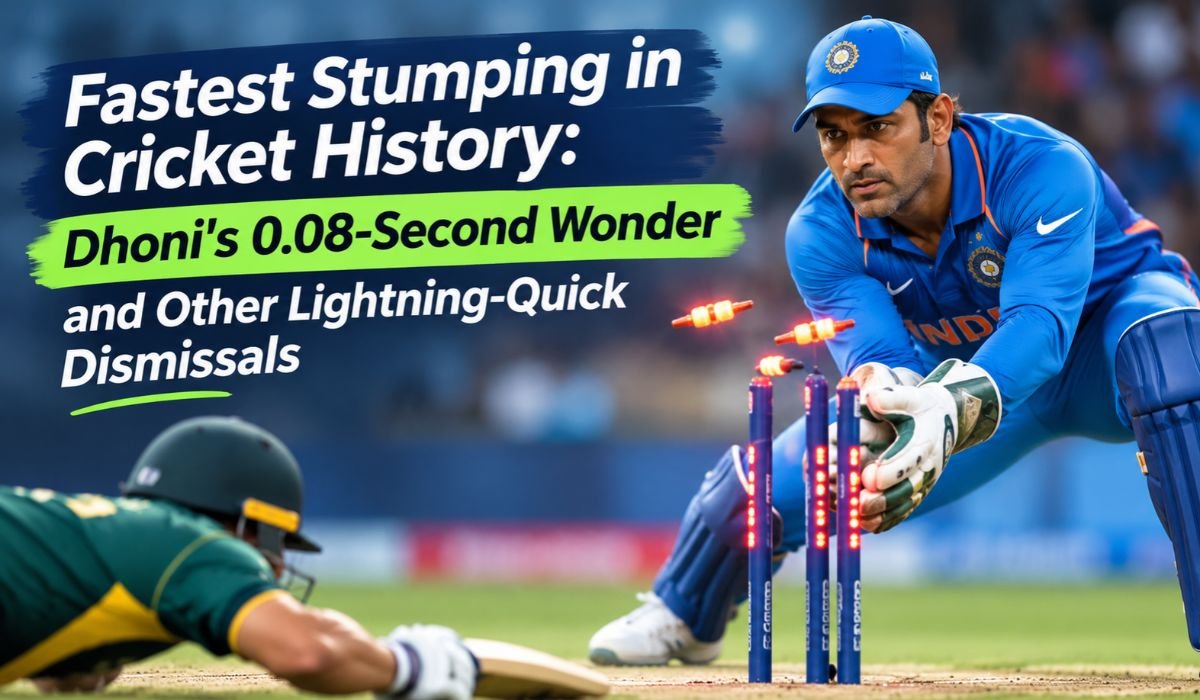
Fastest Stumping in Cricket History: Cricket has some of the most exciting plays with its quick-fire stumpings. At one second the batsman is barely inside his crease, but within a fraction of a second the bails have been dislodged by the wicketkeeper, and the appeal is made. MS Dhoni holds the record for the fastest stumping ever recorded in cricket. He removed the bails from the stumps in a total of 0.08 seconds to dismiss West Indies batsman Keemo Paul during the 2018 series. It is estimated that it takes approximately 0.3 seconds for humans to blink their eyes. Therefore, Dhoni’s stumping was nearly four times faster than the speed at which a person blinks their eyes.
This article will go into great depth about the Fastest Stumping in Cricket History. It will also provide you with information on how this occurred, how it compares to other quick dismissals, how the time for each dismissal is calculated, and what this says about the skills of top-level wicket keepers. Additionally, there are a couple of additional sections that include a comparative chart and six frequently asked questions.
What Is a Stumping in Cricket?
A “stumping” occurs when the wicket-keeper dislodges one of the bails from the wicket, using either the ball itself or the hand that contains the ball, while the batsman is positioned outside his/her crease and does not attempt to score a run. This type of dismissal generally occurs against spin bowlers, where the keeper stands close to the stumps and the batsman advances down the pitch to attack or miscalculates the trajectory of the ball.
A lot of things need to happen for a stumping to be successful. A batsman needs to fail to hit the ball; a wicketkeeper needs to cleanly catch the ball; and the bails must be removed from the top of the stumps in one continuous movement. After most stumpings have occurred, they are reviewed by the third umpire. The fastest stumping ever recorded in cricket is measured based upon how long it took the ball to reach the wicketkeeper’s gloves after hitting the bat, until the bails were removed from the stumps.
The Fastest Stumping in Cricket History: Dhoni vs Keemo Paul
The fastest stumping ever in international cricket occurred in the 4th ODI of India’s 2018 Home Series against West Indies. Keemo Paul, who was a very young man at the time, stepped away from his batting position to try and hit the ball, but he failed to connect with it. As soon as Dhoni received the ball, he immediately knocked over the stumps so fast that Paul didn’t even have a chance to turn around and see what was happening behind him. According to many reports, when Paul did eventually turn around to look for the source of the noise, he saw that his back leg had slipped slightly past the crease line.
The fastest stumping in the world is currently held by Dhoni with a time of.08 seconds. He was able to achieve such quickness due to several factors including keeping his glove low to the ground, bringing his hands straight back to the stumps in one continuous motion, and getting himself into position to move across the wicket before he even took the ball. All of these elements combined made for very little wasted motion.
Top Fastest Stumpings Compared
Below is a list of the most rapid stumpings reported in the media as occurring in cricket matches. All of these times have been analyzed using broadcast data, not through the official ICC statistics, therefore, there may be some variation between different sources. In every listing of the fastest stumpings in cricket history, Dhoni is listed at the top.
| Rank | Wicketkeeper | Batter | Time (seconds) | Year | Match / Format |
| 1 | MS Dhoni | Keemo Paul | 0.08 | 2018 | India vs West Indies, ODI |
| 2 | MS Dhoni | Mitchell Marsh | 0.09 | 2012 | Reported in the 2012 season |
| 3 | MS Dhoni | Shubman Gill | 0.10 | 2023 | CSK vs GT, IPL final |
| 3 | Ben Cox | Calum MacLeod | 0.10 | 2018 | Worcestershire, T20 Blast |
| 5 | MS Dhoni | Suryakumar Yadav | 0.12 | 2025 | CSK vs MI, IPL |
Here is a second table showing Dhoni’s wicketkeeping numbers alongside his speed record.
| Record | Holder | Figure |
| Quickest stumping on broadcast | MS Dhoni | 0.08 seconds |
| Most stumpings in international cricket | MS Dhoni | 195 |
| Most stumpings in ODIs | MS Dhoni | 123 |
| Most stumpings in T20Is | MS Dhoni | 34 |
Dhoni’s Other Lightning Stumpings
Dhoni’s achievement was not based upon a single fluke. At 0.09 seconds, Dhoni’s stumping of Mitchell Marsh in 2012 became the fastest recorded. Marsh was lured forward from his crease by a flighted ball, missed it, and the bails flew off before you could say “catch.” While there are conflicting reports as to whether the event took place during an International T20 or a Domestic T20 match, the time is commonly referenced.
The stumping of Shubman Gill during the 2023 IPL final took 0.10 second. Gill was hitting the ball well, and Dhoni’s quick hands stopped him immediately. In 2025, Dhoni stumped Suryakumar Yadav with speed similar to the Gill stumping (0.12 second). This wasn’t the fastest stumping ever made, but it demonstrated that Dhoni still possessed rapid reflexes despite being in his mid-40s.
Ben Cox and Other Quick Keepers
There are other keepers on these lists besides Dhoni. For example, Ben Cox of England has a stumping of Calum MacLeod from 2018 that ranks second all-time according to some lists. Brendon McCullum’s stumping of Ricky Ponting is listed as one of the fastest stumpings in history. Since there is no official timing equipment used during games, the order of the fastest stumpings ever made in cricket depends upon analyzing each individual frame of the video footage. This means that if you look at multiple different lists, you may find that some of the lower-ranked stumpings have moved around.
How Is Stumping Speed Measured?
No official body maintains a record of stumping speeds. The times for stumpings are derived from slow motion video of live broadcasts, where analysts measure how long it takes for the ball to be caught by the wicketkeeper until the bails are knocked off the stumps. Since most television cameras operate at a minimum of 25 to 50 frames per second (or more), even a slight difference in timing will become apparent.
Because of this, the Fastest Stumping in Cricket History will always be referred to as a broadcast record. A faster stumping might have occurred in a game with poor filming or timing. However, each credible list has Dhoni’s 0.08 seconds listed first.
The Science of Speed Behind the Stumps
The average time for humans to react to a visual signal is approximately 0.2 seconds. A stumping made in 0.08 seconds is faster than this, indicating that the wicket-keeper did more than just respond. Top-level wicket-keepers analyze the batter’s physical cues, the bowler’s hand release, and the projected path of the ball prior to its arrival. Their hands begin to move towards the stumps prior to the ball arriving.
The key to being able to produce the Fastest Stumping in Cricket History lies in the fact that the keeper will have practiced for thousands of hours and, therefore, is able to anticipate when the ball is going to come to him. This is why it is extremely rare for a keeper to perform at such a high level again.
Skills Needed for a Lightning Stumping
Great stumpings depend on a few key skills:
- Soft hands: The gloves must “give” with the ball so it does not bounce away.
- Clean Footwork: The goalkeeper should maintain balance and be side on, only taking steps that are necessary.
- Eyes on the ball: Watching the ball into the gloves prevents fumbles.
- Economy of motion: The hand sweeps from the ball to the bails in one short arc.
Dhoni’s characteristic calm under pressure enabled him to complete the fastest stumping in cricket history with no evidence of panic.
Why Fast Stumpings Matter
When a batsman is stumped quickly, it can often determine which team will win the game. In Twenty20 Cricket, one single dismissal can break apart a threatening partnership and give the advantage to another team. A batsman that steps outside his/her crease to make an attacking shot has virtually no time to regain control of the situation. Therefore, the smallest amount of time can be critical when the third umpire reviews the video. Also, having fast hands creates a lot of pressure on batsmen. They may hesitate to step out of their creases against a wicket keeper such as Dhoni.
These moments are the legacy of cricket for fans. No one ever forgets the Fastest Stumping in Cricket History because it transforms a technically challenging skill into an instantaneous performance.
Dhoni’s Legacy as a Wicketkeeper
Dhoni was considered to be one of the best wicketkeepers of all time when he retired. He had 195 international stumpings, including 123 in ODIs and 34 in T20Is. He had significantly more stumpings than any other wicketkeeper in both limited-overs format. Not only did Dhoni lead India to victory at the 2007 T20 World Cup, the 2011 ODI World Cup, and the 2013 Champions Trophy, but also his wicketkeeping was instrumental in changing the way people viewed wicketkeeping. This can best be demonstrated by the fastest stumping ever made in cricket history.
Can the Record Be Broken?
In theory, yes; however, it is likely to be difficult. Keeper’s like Rishabh Pant, Jos Buttler and Alex Carey have quick hands and attacking mindsets and therefore, can create a faster stumping on the correct day. To create a faster stumping they require a batter who misses the ball, advances slightly too far out from the crease, and loses control of their feet while the keeper is in a perfect position.
At that point, a new record would require broadcast evidence. The person who ultimately breaks the fastest stumping in cricket history will have to have an extreme amount of luck along with skill.
Tips for Aspiring Wicketkeepers
- Practise catching the ball using “soft hands” in spin-bowling net practice sessions and reaction drills.
- Work on lateral footwork so your body stays behind the line of the ball.
- Keep your gloves low and your head still as the ball arrives.
- Watch Dhoni’s footage frame by frame to understand his glove-to-bail movement.
- By practicing with a tennis ball and reflex drills you will develop the anticipation necessary to achieve the Fastest Stumping in Cricket History.
Conclusion
MS Dhoni’s quick 0.08 second dismissal of Keemo Paul is much more than just a number. It represents the perfect combination of timing, anticipation, and quick thinking (calm) hands that occur in one instant. He also has some of the quickest hand reactions to stumping attempts such as Marsh (0.09 seconds), Gill (0.10 seconds), and Suryakumar (0.12 seconds). This makes him a very strong candidate for being the Fastest Stumping in Cricket History.
TheFastest Stumping in Cricket History is likely to stay that way until another wicketkeeper does it even faster. The record is a reward for patience, practice and understanding the game, and it shows why cricket is so unique.
FAQs: Fastest Stumping in Cricket History
1. What is the fastest stumping in cricket history?
The fastest stumping recorded in cricket history was done by MS Dhoni against Keemo Paul of the West Indies in 2018. This stumping was completed in only 0.08 seconds.
2. Who holds the record for the most stumpings?
MS Dhoni has the most international stumpings (195), as well as 123 ODI stumpings and 34 T20I stumpings.
3. Which stumpings come after Dhoni’s 0.08-second effort?
Dhoni’s stumping of Mitchell Marsh, which took place over 0.09 seconds, is typically considered the second fastest. Following that are Dhoni’s stumping of Shubman Gill and Ben Cox’s stumping of Calum MacLeod, both taking 0.10 seconds.
4. Is the 0.08-second stumping an official ICC record?
No. The ICC doesn’t have an official clock for timing stumpings. This number is based on reviewing video of the broadcast, and it has been widely accepted by both the media and fans.
5. How long does a human blink take compared to a stumping?
A blink takes approximately 0.3 seconds, which means that Dhoni’s 0.08 second stumping was almost 4 times quicker than a blink.
6. Has any wicketkeeper stumped a batter faster than Dhoni?
Dhoni’s 0.08 second stumping is the fastest to have ever been documented and credible. While there may be some claims that have been made, none of these have been documented on film.