

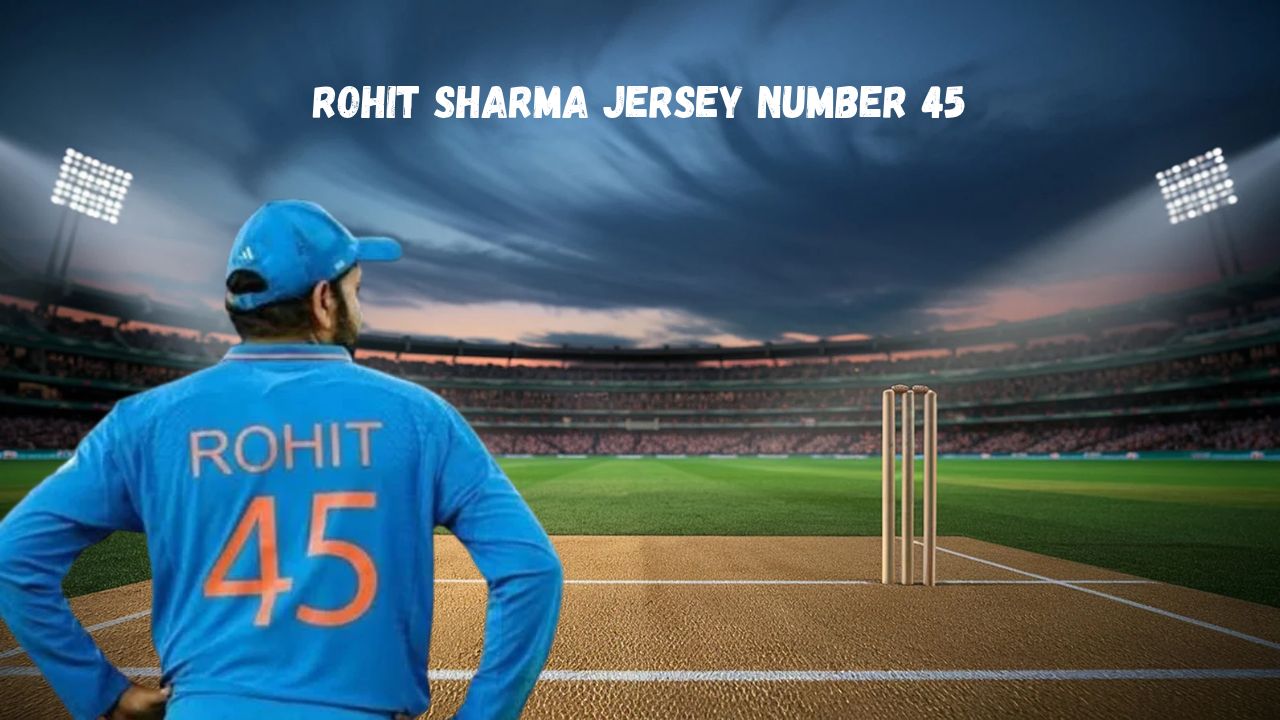
Rohit Sharma’s jersey number is 45, a number closely associated with his career for India and recognised across cricket grounds, supporter displays and fan apparel. His international profile lists No. 45 for both ODI and T20I cricket, while also recording that he previously wore No. 77. Although a popular explanation links the choice of 45 to a personal lucky-number calculation, there is no detailed official account in the available record confirming the complete story behind the selection.
Why Rohit Sharma Is Known as No. 45
For most cricket followers, “Rohit 45” is an instantly familiar combination. It appears on India supporter jerseys, social-media handles and fan-made graphics because the number has accompanied Sharma through a substantial part of his international career. His profile lists 45 as his ODI and T20I shirt number, making it the number most strongly connected with his identity in limited-overs cricket.
The attachment is not merely about a shirt design. Jersey numbers become useful shorthand in a sport where players often build long careers across international cricket, domestic competitions and franchise leagues. A recognisable number can become part of how supporters identify a batter, captain or match-winner, particularly when the player’s career includes major tournaments and memorable performances.
Sharma’s No. 45 gained that visibility alongside a career that began with his ODI debut against Ireland on 23 June 2007 and his T20I debut against England on 19 September 2007. He went on to play for India across formats, represent Mumbai in domestic cricket and play for Mumbai Indians in the Indian Premier League.
The Story Commonly Linked to Number 45
A widely circulated explanation says that 19 was Sharma’s preferred number but was unavailable, after which he spoke to his mother and chose 45. The same version says that the sum of four and five equals nine, considered his lucky number. This account has become popular in short-form cricket content and fan discussions.
However, it is important to distinguish a frequently repeated anecdote from a fully documented official explanation. The available player profile confirms No. 45 and notes that Sharma formerly wore No. 77, but it does not provide a direct quotation from Sharma explaining why he chose 45. Therefore, the lucky-number account is best understood as a popular story associated with the jersey rather than a conclusively documented origin.
That distinction matters because sporting folklore often becomes more certain in retelling. The number itself is clear: 45 is Sharma’s listed ODI and T20I shirt number. The exact personal decision-making behind it is less clearly established in published player information.
No. 45 Was Not His Only International Shirt Number
Sharma’s international profile records that he formerly wore No. 77 in ODIs and T20Is before being listed with No. 45. This shows that a player’s shirt number can change during a career, especially across different stages, squad arrangements or kit periods.
The later prominence of 45 means that many fans may not immediately connect Sharma with 77. Yet the earlier listing is a reminder that jersey numbers do not always begin as permanent personal symbols. Their meaning can grow gradually as a player plays more matches, delivers defining innings and occupies important roles within the side.
For Sharma, 45 became the number seen during the period in which he established himself as one of India’s leading white-ball batters and later a major leadership figure. That longevity helped make the number memorable in a way that an earlier shirt number was not.
How the Number Became Part of His Cricketing Identity
A jersey number acquires significance when it repeatedly appears in moments supporters remember. Sharma’s career contains plenty of those moments. He is listed as holding the record for the highest individual score in a men’s ODI: 264. He also holds the record for three double centuries in ODI cricket and has seven Cricket World Cup centuries.
These achievements do not explain why 45 was selected, but they explain why it became meaningful to supporters. When fans see the number, they connect it with the player’s batting style, big-score reputation and long association with Indian cricket. It has become a compact visual reference for a career that has produced landmark performances in the 50-over format.
His record also extends beyond individual runs. Sharma was part of India’s winning squads at the 2007 T20 World Cup and the 2013 ICC Champions Trophy. As captain, he led India to the 2024 T20 World Cup and the 2025 ICC Champions Trophy titles. Such achievements strengthened the public association between Sharma and his familiar jersey number.
A Number Linked With Leadership
No. 45 also remained visible through a major change in Sharma’s role: his rise from leading batter to captain. He formerly captained Mumbai Indians, with the team winning Indian Premier League titles in 2013, 2015, 2017, 2019 and 2020 under his leadership. He later became captain of India across formats.
That transition adds another layer to the jersey’s recognition. For younger viewers, 45 can represent not only a top-order batter but also a captain responsible for setting the tone of a side. In cricket, numbers often outlive individual seasons because they hold memories from different phases of a player’s journey.
The Difference Between Official Shirts and Fan Jerseys
When discussing a player’s jersey number, it helps to separate official match shirts from commercial fan clothing. The number 45 is associated with Sharma’s India appearances, but fan jerseys can vary in colour, typography, fabric and design depending on the seller and the season they are trying to represent.
Many products use “Rohit 45” because the combination is immediately recognisable. Yet a supporter shirt should not automatically be treated as an exact copy of an official India match jersey. Retail listings may describe generic fan wear, and designs can differ from kit to kit.
For readers following team news, player roles and likely line-ups around an upcoming match, a considered dream11 prediction can be more useful when it focuses on match conditions, squad context and player roles rather than jersey associations alone. A number may identify a cricketer, but selection decisions depend on form, venue and the format being played.
What Jersey Numbers Mean to Cricket Supporters
Cricket jersey numbers are not always based on one fixed rule. A player may choose a number for personal reasons, availability or a simple preference. In other cases, supporters attach their own meaning to it after years of watching the player perform.
The strongest examples tend to be those where the number stays consistent through important chapters of a career. Sharma’s No. 45 has benefited from exactly that. It has been visible during international tournaments, ODI milestones, captaincy years and his continuing association with Indian cricket.
There is also a practical appeal. “45” is simple, easy to remember and visually distinct on a shirt. That helps it travel easily from the back of a player’s match jersey to posters, banners and fan clothing. Over time, it becomes part of the supporter language around the player.
The Lasting Significance of Rohit’s No. 45
Rohit Sharma’s jersey number 45 is best understood as a familiar symbol of his cricketing journey rather than a statistic or a tactical detail. The available records establish 45 as his ODI and T20I shirt number and show that he previously wore 77. The popular lucky-number explanation adds colour to the story, though its full origin is not officially documented in the available player record.
Ultimately, No. 45 carries its importance because of the career attached to it: major ODI achievements, tournament victories, IPL captaincy success and leadership for India. That is why the number remains one of the most recognisable jersey identifiers in Indian cricket.